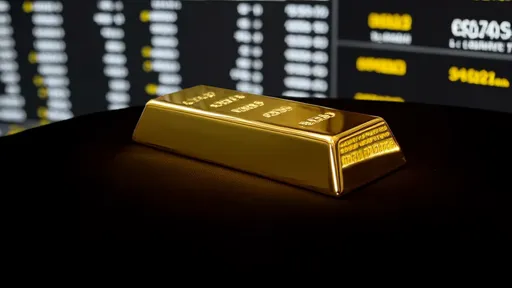
Gold prices shattered all previous records in early trading today, breaching the $4,200 per ounce barrier for the first time in history. The landmark moment sent shockwaves through global financial markets, with the precious metal's relentless ascent defying conventional market wisdom and leaving analysts scrambling to reassess their forecasts. Trading floors from London to Hong Kong witnessed frenetic activity as the spot price touched $4,202.35 before settling slightly lower, still comfortably above the psychologically significant threshold.
The surge represents the culmination of a perfect storm of economic uncertainties that have been brewing for months. Central banks worldwide have been accumulating gold reserves at unprecedented rates, with emerging economies particularly active in diversifying away from traditional reserve currencies. This institutional buying pressure has created a solid foundation beneath gold prices that retail investors have enthusiastically built upon. Market veterans who've witnessed multiple gold cycles throughout their careers confess they've never seen such sustained institutional interest in the yellow metal.
What makes today's breakthrough particularly remarkable is the context in which it occurred. Conventional financial theory suggests gold should struggle in a high-interest-rate environment, yet the metal has continued its upward trajectory despite aggressive monetary tightening by major central banks. This apparent contradiction has forced economists to reconsider traditional models that have governed asset allocation decisions for decades. The very foundations of modern portfolio theory are being tested as gold demonstrates its resilience across diverse economic conditions.
Geopolitical tensions have provided jet fuel for gold's recent acceleration. The ongoing conflicts in Eastern Europe and the Middle East, combined with simmering tensions in the South China Sea, have created a pervasive sense of uncertainty that drives investors toward safe-haven assets. The metal's historic role as a store of value during times of political instability is being reaffirmed daily as new flashpoints emerge across the global landscape. Defense analysts note that we're witnessing the most complex geopolitical environment since the Cold War, and financial markets are responding accordingly.
Inflation concerns, while somewhat tempered from their peaks last year, continue to linger in the background of investment decisions. The memory of rapid price increases remains fresh in consumers' minds, and many wealth managers report clients expressing skepticism about official inflation statistics. This underlying distrust of fiat currencies and their managing institutions has driven a segment of investors toward gold as an inflation hedge, regardless of current CPI readings. The psychological impact of recent inflationary spikes appears to have permanently altered some investors' approach to wealth preservation.
The technological landscape has also played a crucial role in gold's accessibility and appeal. Digital gold platforms and gold-backed cryptocurrencies have democratized access to the metal, allowing smaller investors to participate in markets that were previously dominated by large institutions and wealthy individuals. This technological democratization has introduced a new source of demand that simply didn't exist during previous gold bull markets. Fintech innovations have essentially created a bridge between traditional safe-haven investing and modern digital finance.
Mining industry executives express both excitement and concern about the current price environment. While higher prices obviously benefit their bottom lines, they also create expectations among shareholders that may be difficult to sustain through normal production cycles. More importantly, the industry faces significant challenges in increasing supply to meet growing demand. New gold discoveries have become increasingly rare, and developing new mines typically requires a decade or more of regulatory approvals and infrastructure development before production can begin.
The environmental and social dimensions of gold mining have added another layer of complexity to the supply equation. Responsible sourcing initiatives and increased scrutiny of mining practices have raised production costs while limiting potential supply from regions with questionable environmental or labor standards. These developments have fundamentally altered the economics of gold production, creating a higher cost floor beneath prices that may prevent significant corrections even if investment demand temporarily wanes.
Currency markets have developed an increasingly intricate relationship with gold prices in recent months. The traditional inverse correlation between the US dollar and gold has shown signs of breaking down as global investors seek protection against currency risks beyond just dollar depreciation. The metal is increasingly being viewed as a hedge against broader fiat currency uncertainty rather than simply a play on dollar weakness. This evolution in perception represents a significant shift in how market participants conceptualize gold's role in a diversified portfolio.
Looking forward, analysts are divided about how much higher gold can climb from current levels. The most bullish forecasts suggest we could see $5,000 per ounce within the next eighteen months if current macroeconomic trends persist. More conservative voices warn that the market may be entering bubble territory and caution investors against chasing the rally at these elevated levels. What nearly all observers agree on, however, is that the factors driving gold higher are structural rather than cyclical, suggesting that the metal may have established a new permanent plateau well above previous historical ranges.
The psychological impact of breaching $4,200 cannot be overstated. Round numbers often serve as powerful psychological barriers in financial markets, and their breach typically triggers fresh waves of buying from momentum investors and technical traders who use these levels as signals for entry. The fact that gold has so decisively overcome this barrier suggests that further gains may come more easily than many skeptics anticipate. Market technicians note that the charts show clear air above current prices with few obvious resistance levels until much higher thresholds.
Perhaps the most significant aspect of gold's record run is what it says about the global financial system itself. The persistent demand for this ancient store of value in our digitally sophisticated era suggests deep-seated concerns about the stability and integrity of modern financial architecture. When investors choose to park significant wealth in an asset that produces no yield and incurs storage costs, they're making a powerful statement about their assessment of relative risks across the investment landscape. This behavior represents a vote of no confidence in more complex financial instruments and the institutions that create them.
The ramifications extend beyond financial markets into the real economy. Jewelry manufacturers and electronics companies that rely on gold as an input material are facing difficult decisions about how to manage their costs amid this unprecedented price environment. Some are exploring alternative materials, while others are attempting to pass increased costs along to consumers already grappling with broader inflationary pressures. These dynamics could potentially reshape multiple industries if gold prices remain at elevated levels for an extended period.
As the trading day concluded, gold settled at $4,198.75, having established a new paradigm for what's possible in precious metals markets. The breakthrough has rewritten record books and forced a recalibration of risk models across the financial industry. Whether this represents a temporary peak or just another waystation on a journey to even more unimaginable levels remains the dominant question occupying the minds of everyone from central bankers to individual investors. What's certain is that the world woke up to one reality this morning and will go to sleep tonight in a fundamentally different financial universe.

By /Oct 16, 2025

By /Oct 17, 2025

By Daniel Scott/Oct 16, 2025

By Emma Thompson/Oct 16, 2025

By /Oct 16, 2025

By /Oct 16, 2025

By /Oct 17, 2025

By /Oct 17, 2025

By /Oct 16, 2025

By Christopher Harris/Oct 16, 2025

By /Oct 16, 2025

By /Oct 17, 2025

By Thomas Roberts/Oct 16, 2025

By /Oct 17, 2025

By /Oct 17, 2025

By /Oct 17, 2025

By /Oct 16, 2025

By /Oct 17, 2025
By /Oct 17, 2025

By /Oct 17, 2025
