In the ever-evolving landscape of fashion, where trends flicker and fade with seasonal regularity, designer Glenn Martens has pioneered a radical approach that challenges the industry's fundamental rhythms. Rather than treating each collection as an isolated statement, Martens conceives of his work as a continuous, evolving "clothing family." This philosophy, most prominently manifested through his transformative work at Y/Project and Diesel, represents a paradigm shift from disposable fashion to a narrative of permanence, evolution, and interconnectedness. It is a deliberate move away from the shock-of-the-new towards the comfort and complexity of the familiar, reimagined.
The concept of a "clothing family" is more than a mere marketing slogan; it is the core tenet of Martens' creative DNA. Imagine a vast, sprawling lineage where each new season is not a distant cousin but a direct descendant, carrying the genetic code of its predecessors. Key silhouettes, signature manipulations, and distinctive design languages are not discarded but are instead refined, recontextualized, and allowed to mature over time. The iconic twisted jeans, the layered jackets, the deconstructed tailoring—these are not one-hit wonders but recurring characters in an ongoing saga. They appear, then reappear with subtle alterations, new fabrications, or in unexpected combinations, much like a family heirloom passed down and adapted by each generation. This method fosters a deep sense of identity and continuity, building a world that customers can re-enter season after season, discovering new layers of meaning in familiar forms.
At the heart of this familial structure lies a profound commitment to design evolution over revolution. Where many designers feel pressured to repeatedly reinvent the wheel, Martens finds richness in depth. He delves into the possibilities inherent within a single idea, exploring its permutations with the dedication of a sculptor refining a form. A sleeve detail introduced in one collection might become the focal point of a garment two seasons later. A specific drape or fold is studied, manipulated, and pushed to its logical extreme over the course of several years. This patient, iterative process results in clothing that feels both considered and intelligent. It rewards the observant eye, creating a secret language between the designer and his audience—a nod to those who have followed the journey and can appreciate the subtle references and progressions.
This philosophy naturally cultivates an intense and loyal community around Martens' brands. Consumers are not merely purchasing a standalone item; they are acquiring a piece of a larger, living narrative. There is a tangible joy and intellectual satisfaction in recognizing the lineage of a garment, in understanding its place within the broader family tree. This transforms the act of shopping from a transactional event into an act of cultural participation. Followers of Y/Project, for instance, engage with each collection as a new chapter in a book they are already invested in, discussing how the new pieces relate to archival favorites. This builds a powerful, self-sustaining ecosystem where the value of each piece is amplified by its connection to the whole.
Sustainability, both conceptual and practical, is an inherent byproduct of Martens' familial approach. In an industry rightly criticized for its wastefulness, the practice of building upon a foundation rather than constantly starting from scratch is a quiet act of rebellion. By refining and reissuing core designs, Martens implicitly argues for longevity and timelessness. These are not clothes designed for a single season's photo op; they are designed to evolve with the wearer and remain relevant as the family itself grows. This challenges the very premise of fast fashion, suggesting that the most desirable clothing is not that which is newest, but that which possesses a rich history and a promising future. The emotional durability matches the physical, reducing the impulse for cyclical consumption.
Martens' technical prowess is the engine that makes this entire concept viable. His garments are often complex feats of construction—asymmetrical zippers, multi-layered collars, and distorted patterns that require immense skill to execute. This complexity ensures that the designs cannot be easily or cheaply replicated, protecting the integrity of the "family lineage." The clothing demands to be studied and appreciated over time, its intricacies revealing themselves gradually. This technical depth provides a solid foundation for evolution; without a strong and distinctive core language to begin with, the idea of a continuous family would lack substance. The experimentation is always grounded in expert craftsmanship, ensuring that even the most avant-garde pieces feel intentional and wearable.
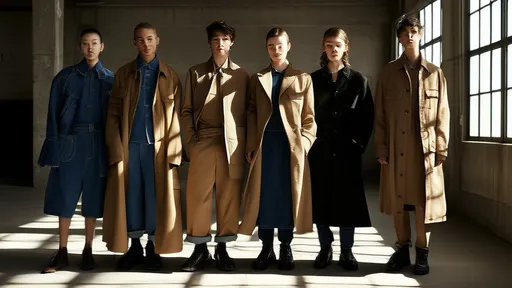
The application of this philosophy is distinctly visible across his two primary houses. At Y/Project, the family is intellectual, artistic, and avant-garde. The lineage is one of conceptual play, where tailoring is deconstructed and denim is sculpted into impossible forms. The narrative is about challenging the boundaries of what clothing can be. At Diesel, Martens applies the same familial thinking but on a massively democratized scale. Here, the family is global, energetic, and rooted in the codes of heritage workwear, which he subverts with his signature twists. The ripped jeans, the logo treatments, the oversized silhouettes—they are all becoming part of a new, rebellious Diesel lineage, reintroducing the brand to a generation by building a consistent and exciting new identity.
Ultimately, Glenn Martens' vision of a "clothing family" is a powerful antidote to the fragmentation and ephemerality of contemporary fashion. It is a holistic system that prioritizes narrative, community, and intelligent design over fleeting trends. In a world saturated with disposable imagery and products, Martens offers something far more valuable: a sense of belonging. He is not just selling clothes; he is inviting us into a world, a story, and yes, a family—one that is constantly growing, changing, and welcoming us back, season after season. This approach doesn't just create customers; it creates devotees who are invested in the long-term story, ensuring that the family tree will continue to branch out for years to come.
By /Oct 23, 2025

By /Oct 23, 2025

By /Oct 22, 2025
By /Oct 23, 2025

By /Oct 23, 2025
By /Oct 22, 2025
By /Oct 23, 2025
By Eric Ward/Oct 22, 2025
By Natalie Campbell/Oct 22, 2025
By /Oct 22, 2025

By /Oct 23, 2025

By /Oct 31, 2025
By /Oct 23, 2025
By /Oct 22, 2025

By /Oct 22, 2025
By /Oct 22, 2025

By /Oct 23, 2025

By /Oct 23, 2025
By /Oct 23, 2025

By /Oct 22, 2025
